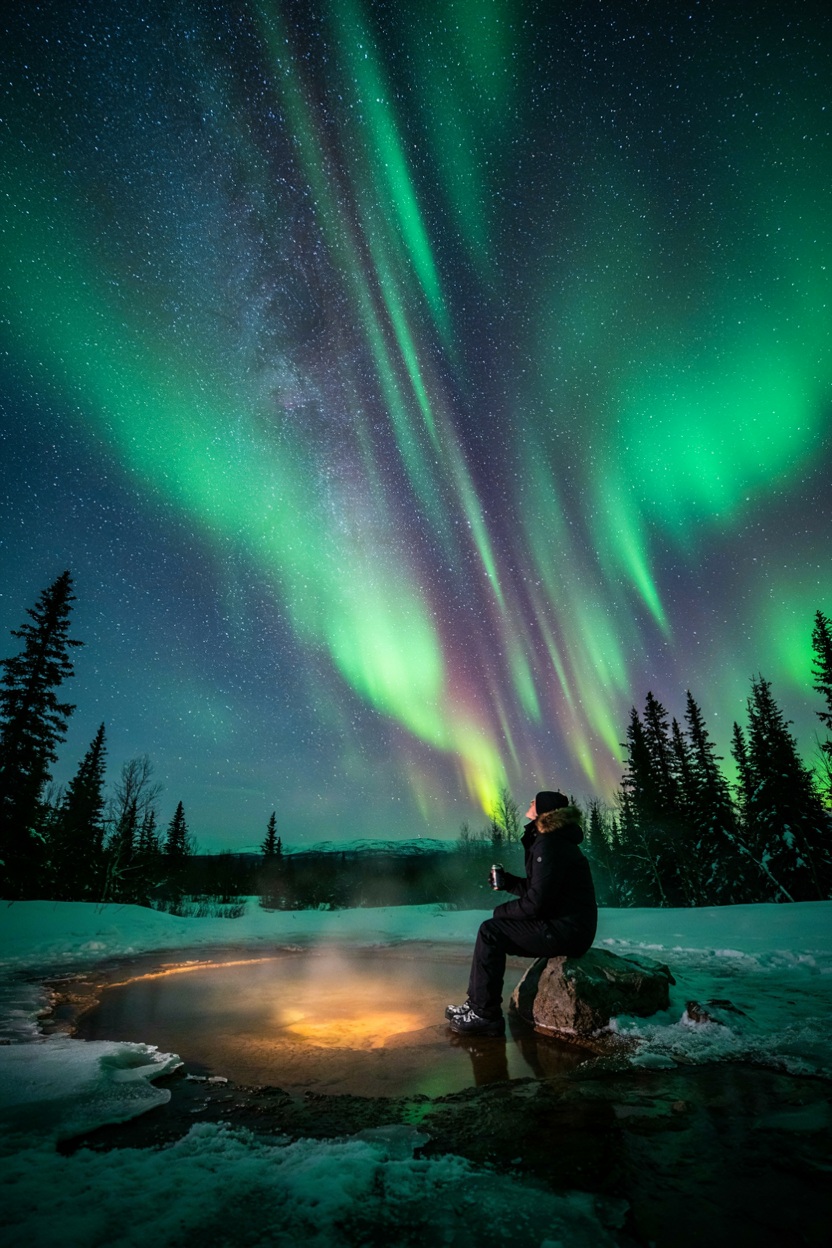
10 Aurora Apocalypse Destinations
The Green Dances That Rewrote My Life (And Will Change Yours Too!)
The Northern Lights don’t just let you see them—they rebirth you. Over the past decade, I woke in the world’s most luxurious hotels, tasted the masterpieces of Michelin chefs, but none of them gave me what the Arctic offered: a profound, frightening sacredness. Here’s what you need to know: to witness this melody painted across the sky, you must tear yourself from the city’s warm embrace. You must abandon the comfort of refinement and shiver at -40°C. And here, after ten years of Arctic pilgrimage, I’ve come to pull you into this green embrace. Every location is a calling; every moment, a divine wish for me. If you love luxury, if you want to lose yourself in history’s cold stones, if you’re ready to surrender to nature’s terrible beauty—this guide is the sacred pages of your own book.
Yellowknife, Canada – The Heartbeat of the Arctic
On my first flight to Yellowknife, I was told “it’s a place where you go to die and reach heaven”—and truly, no expectation could compete with this reality! On the quiet shores of Hay River, in this Arctic town, I found my own spiritual capital. The Aurora Borealis Belt passes directly through here; at midnight, millions of miles from light pollution, the sky launches a private show just for you: an emerald-green curtain unfolds, trembling with pink and violet sparkles—as if the universe has synced to your heartbeat. Yellowknife itself is bohemian, starved for adventure, saturated with aurora passion—pulling you into its community of souls.
A 4-hour flight from Toronto; in February’s cold embrace, I spent 5 nights watching the fire dance at Conibear Cabin Resort. There’s no difference between this place and Yellowknife—same soul. There: I stepped onto the frozen rivers of Dettah, learning the Arctic’s secret language from an indigenous guide; I boarded a boat on Hay River, acquiring the habit of waiting for aurora’s emergence; I ate a Canadian bison like communion at The Brewery (that historic log cabin bar); I dreamed the most beautiful lie—becoming a pilot—at the Aviation Heritage Museum.

Location: Yellowknife, Northwest Territories, Canada | Size: ~19,000 souls | Spirit: Adventure-giving, geography-igniting, aurora-intoxicating
My Sacred Moments: By Conibear’s fire, with local tea in my hands, the green curtain outside danced. Heat inside, frozen outside; they merged in the same heartbeat. On Hay River’s shore, I ate fresh pike fillet (sauced with wild mushrooms)—wasn’t this the taste of Canada’s own heart?
Tromsø, Norway – Geometric Holiness
Before coming to Tromsø’s guide, I already knew—but no knowledge could prepare me for this experience. On my first night, the sharp, squared edges of the Arctic Cathedral meet the aurora’s curved ribbons. It’s as if architecture and cosmos are speaking to each other. I found something beyond beauty here—Norway’s soul, confessing itself through white geometry and green light. The city, from every street, every angle, is like a painter’s canvas: minimalist, misty, illuminating the very moment you begin questioning.
Upon arriving in Tromsø (January, fresh snow), I slept under the roof of Aurora Borealis Lodge for 6 nights—Sami design, wooden body, minimalist spirit. There: I photographed the Arctic Cathedral each morning (discipline); I ran with dogs at Tromsø Villmarkssenter, learning Sami culture (belonging); I ventured to the fjord, waiting for whales (patience); I ate reindeer almost peacefully in Stian’s restaurant (community).

Location: Tromsø, Nord-Trøndelag, Norway | Size: ~76,000 souls | Spirit: Elegant yet wild, culture and nature merging
My Sacred Moments: In Aurora Borealis Lodge’s sauna, steam and green light merged in the same heartbeat. Then I walked on snow—from heat to cold, from structure to nature. At Stian’s door, I spoke with a local Norwegian woman, eating reindeer meatballs (slow-braised, lingonberry compote)—history and taste, hand in hand.
Fairbanks, Alaska – The Merger of Contrasts
Fairbanks is geographically the heart of aurora—this is where the Northern Lights Belt intersects. Flying from Seattle (2.5 hours), I was already passing between gates: warm and frozen. From the log cabin window of Creekside Cottages, the sky frequently hurls green ribbons. I completely fell in love with the raw contrast here—Chena’s hot water, embracing snow; my body warm, my world frozen. I’ve never tasted this duality anywhere else.
In mid-March I stayed 7 nights (aurora still visible, days longer). At Chena, I acquired the habit of sitting between ice and fire, waiting for aurora; I ascended Denali (adventure); I ate Alaska sushi at Pike’s Waterfront (salmon roe, local berries—fish and plants merged); I drank coffee with sourdough at Pattypan (beginning and end).

Location: Fairbanks, Alaska, USA | Size: ~30,000 souls | Spirit: Raw, contrasting, dualist
My Sacred Moments: Sitting in Chena’s hot water, the sky convulsing with green waves—my entire body felt aurora’s frequency. Meal: At Pike’s Waterfront, I ate Alaska halibut fillet with wild berry salsa—raw fish, fresh plant, cold air = Alaska’s entire sentence on a single plate.
Reykjavik, Iceland – The Genesis of Earth
When people mention Iceland, they say Blue Lagoon—but I’m telling you, the real magic begins once you leave Reykjavik. While the city glimmers with aurora, the sacred dance happens at Jökulsárlón and Thingvellir. I discovered the moment when earth whispers its creation—here, the world exists as an unfinished civilization, lava and glacier in the same breath, the aurora’s green light understanding the entire story. Creation, timelessness, a sacred stage.
From Keflavík, 45 minutes (crossing civilization’s line). In December’s misty smile, I stayed 8 nights at The Leif Espresso Hotel—design intimate, spirit bright. There: I stepped into Thingvellir’s tectonics, standing between two continents = at the edge of two worlds; I sailed through Jökulsárlón with icebergs (their silence and aurora’s smile); I toured the Golden Circle (geyser, waterfall = nature’s words); I ate Iceland langoustine at Dill—the ocean’s most delicate part, on Reykjavik’s table.
Location: Reykjavik, Iceland | Size: ~130,000 souls (Metro: 400,000) | Spirit: Geography’s drama, mineral’s blessing, nature’s word
My Sacred Moments: At Thingvellir, where two continents divide, aurora dances—history and cosmos in the same heartbeat. At Matur og Dróp (street café), I ate Arctic scallop (local rye on the side)—this plate = Iceland’s creation moment: soil (rye), sea (scallop), sky (aurora).
Rovaniemi, Finland – Fairytale Reality
Rovaniemi is where fairytales become real. Christmas decorations, reindeer, aurora—this trinity shouldn’t exist, but in Lapland it does. Upon arriving in Rovaniemi (December, snow and light in the same box—it was like opening a storybook’s cover). Rovaniemi itself is magical yet intimate; touched by shamans rather than tour guides. I found myself stepping into a fairytale—but this one never ends.
From Helsinki, a 2-hour flight; in December’s frozen mist, I stayed 5 nights at Arctic TreeHouse Hotel—a tree house, transparent ceiling, aurora’s window. There: Reindeer sledding (cold, movement, traditional ritual); Santa Claus Village (tourist but sacred); Snowmobile safari to Pyhä-Luosto (speed, nature, freedom); Lappish tasting menu at Rovaniemi Hallitus—reindeer, lingonberry, pine nuts (Lapland’s three colors).

Location: Rovaniemi, Lapland, Finland | Size: ~65,000 souls | Spirit: Magical, Christmas-spirited, nature’s song
My Sacred Moments: In Arctic TreeHouse’s glass bed, aurora waking me as I slept—the sky clear, green light touching the same window—this is the only definition of magical. On the reindeer sleigh, at a stop, a Sami nomad prepared fresh reindeer meat, cloudberry and sour cream—Lapland’s true taste, the paradoxical flavor few know.
Svalbard (Longyearbyen), Norway – Beyond the Border
Svalbard, 79°N—the edge of the world. Longyearbyen, the most striking combination of cultural diversity and aurora. This is not just Norwegian; people from Thailand, Philippines, Russia call it home. I discovered an otherworldly landscape—mountains and snowy beach, aurora pouring directly over the city. Monumental and melting. Even ‘postcard-perfect’ falls short! From Funken Lodge’s historic window, I can see civilization’s border.
I flew from Oslo, 5 hours (civilization’s line erased). In February, aurora season’s peak; I stayed 4 nights at Funken Lodge. There: Snowmobile safari to Nordenskiöld Land (wild emptiness); Svalbard Museum exploring polar exploration history (humanity’s limit); Dog sledding (dogs and my body = nature’s gears); Brenneriet (Norway’s northernmost restaurant)—Arctic scallop, polar cod, coal-smoked fish (civilization’s last mouth).

Location: Longyearbyen, Svalbard, Norway | Size: ~2,400 souls | Spirit: International, geographically extreme, aurora’s power
My Sacred Moments: On Funken Lodge’s terrace, drinking Norwegian hot chocolate, green-pink-purple aurora dances high in the sky—a moment most humans will never witness, like being a private witness to the gods. At Brenneriet, I ate Arctic scallop with local rye bread, Arctic halibut and cider reduction—a rare menu at the world’s end.
Kiruna, Sweden – The Transparency of Ice
I reached Kiruna on a Swedish friend’s recommendation—and here’s what happened: the town has almost no bad angles. In Northern Sweden, near Norway’s border, this massive city has ideal aurora latitude (67.8°N) and most importantly—no light pollution! In Kiruna, I found the most refined Nordic aesthetic—minimalist, design-conscious, yet surrendered to the Arctic’s raw power. Aurora here moves in green and purple tones like fabric. The city is transparent, crystalline—there’s nothing to hide.
I flew from Stockholm (2 hours) and stayed 6 nights in January at the Icehotel—yes, THE Icehotel! Suites made of ice, transparent ceiling, the joy of watching aurora from bed. There: Snowmobile safari to Abisko National Park (the blackest night sky on Sweden-Norway border); Dog-sledding in Kiruna (wild ritual); Ice-fishing on Torne River (learning silence with a local Sami guide); Traditional Swedish inn at Rahpis Wärdshus (Reindeer meatballs, cloudberry pie, butter sauce).

Location: Kiruna, Norrbotten County, Sweden | Size: ~17,000 souls | Spirit: Cold design, Arctic wealth, Swedish refinement
My Sacred Moments: In Icehotel’s ice-made suite, Arctic fur blanket over me, watching aurora from bed—cold air, ice crystals, and green light in the sky—sensorially surreal! At Rahpis Wärdshus, by an open hearth fire, slow-roasted reindeer shank and wild lingonberry jam (bought from local Sami)—the moment I truly tasted Northern Sweden’s soul.
.
Whitehorse, Yukon, Canada – Theater Stage
Starting in Canada’s Yukon region via Whitehorse taught me the most. Though not as famous as Yellowknife, Whitehorse’s aurora potential is equal—but far less tourism! Upon arriving in Whitehorse, the town’s ocean-wide expanse and silence gripped me. On Yukon River’s shore, I discovered an intimate relationship between city and nature—civilized town in the center, forest and river holding dominion. Aurora here is more compact but more intense! The city’s atmosphere is a Klondike Gold Rush heritage mixed with modern boutique ventures.
I flew from Vancouver (3 hours) and stayed 5 nights in February at Edgewater Hotel—overlooking Yukon River, wood and glass architecture, mature design. There: Aurora-watching walk on Takhini River (silent waiting); Day trip to Dawson City (Klondike Gold Rush cemetery—the dreams of fortune hunters); Whitehorse Rapids Heritage Centre learning from indigenous Yukon people (culture’s pulse); Edgewater Restaurant dining on Yukon-sourced bison steak, rosehip sauce and wild mushroom risotto (taste and history).

Location: Whitehorse, Yukon, Canada | Size: ~35,000 souls | Spirit: History and design, Yukon romance, hidden gem
My Sacred Moments: On Edgewater Hotel’s private river viewing deck, snowy Yukon landscape and green aurora—coffee in my hand, silence around me—people who don’t come here are missing out! At Edgewater Restaurant, bison steak (cooked over open fire) and yukon wild berry compote—Canada’s frontier spirit perfectly told through food, every piece a history chapter.
Iqaluit, Nunavut, Canada – Primal Sacred
Iqaluit is my bravest choice on this list. Nunavut’s capital, limited technology, minimal tourism infrastructure—but this is exactly how magic hides! Coming to Iqaluit means abandoning the modern world. The aurora phenomenon, as complex as quantum physics, presents here as a massive sky performance. No designed-light spaces; just nature’s direct offering! In this city, I discovered the raw, unfiltered North—Arctic tundra, Inuit culture, aurora science’s source, the place where civilization vanishes.
I flew from Montreal (5-hour transfer!) and stayed 4 nights in March at Arctic Hotel—basic but clean, authentic Inuit hospitality. There: Snowmobile safari on Frobisher Bay (tundra’s desolation); Learning Inuit history at Qamanutiq Heritage Park (thousand years of silence); Inuit art and meeting contemporary artists at Iqaluit Museum (culture’s heartbeat); “Alice’s Cafe” and local restaurants eating Arctic char, seal meat (fok eti) and local mattak (muktuk—whale skin’s underbelly fat)—the food chain itself.

Location: Iqaluit, Nunavut, Canada | Size: ~7,700 souls | Spirit: Primal, Inuit authentic, aurora’s gateway
Murmansk, Russia – Imperial Remnants
Murmansk, writing this in December 2024, maintains its historical and geographical value despite current geopolitical context. On Kola Peninsula, on Barents Sea’s shore, Murmansk sits geographically at aurora zone’s center! The city itself may appear depressing and industrial (Soviet architecture!), but aurora’s likelihood here is high. I found Murmansk to be a paradox—Soviet brutalism and Arctic magic at a single point. Against the city’s colorless ground, green light creates the most dramatic effect. Empire’s remnants, cosmos’s calling, meeting.
I flew from St. Petersburg (3 hours) and stayed 4 nights in January at Sanct Petersburg Hotel—Soviet-style interior design, but decorated with specific Arctic charm. There: Arctic Ocean aurora-watching expedition on Kola Peninsula (with specialist guide—history, science, spirit); Exploring polar exploration history at Murmansk Regional Museum (humanity’s limit); Day trip to Apatity (feldspar mines and geology museum—earth’s inner structure); Murmansk’s oldest Sami restaurant—”Chum Salmon House”—wild salmon soup, cloudberry vodka (Sami’s philosophy).

Location: Murmansk, Kola Peninsula, Russia | Size: ~295,000 souls | Spirit: Soviet culture, Arctic extremism, geopolitical intrigue
My Sacred Moments: On Barents Sea’s shore, Soviet outpost ruins behind me, aurora dancing green leaves across the sky—history and nature shared a single moment, the empire’s final breath exhaling while cosmos sang overhead. At Chum Salmon House, fresh Arctic salmon (raw, local dill and cloudberry compote), and local “murman” vodka—Russia’s Northern concept in a single bowl, empire’s last breath contained.