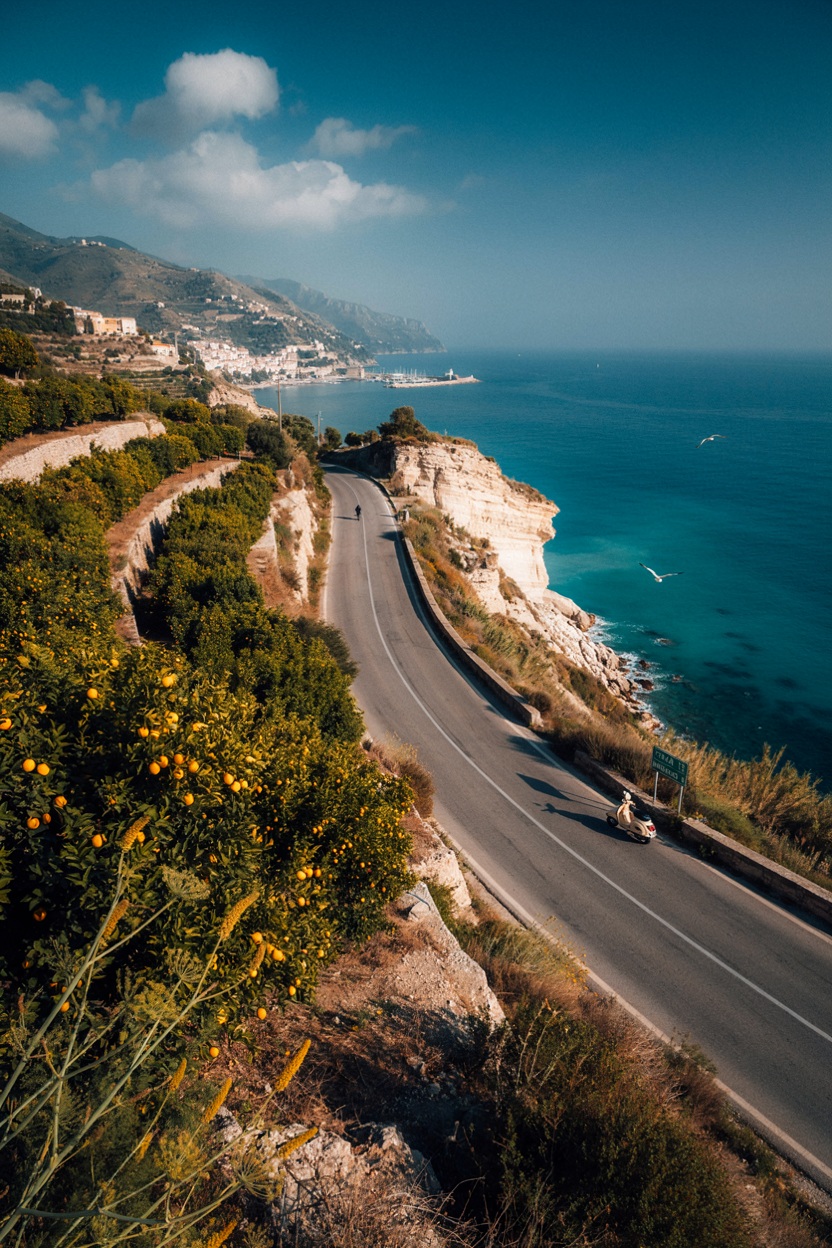
That Completely Captivated My Heart!
INTRODUCTION
Saying Palermo is like calling the name of someone who once lived there—it immediately whisks me back to those streets, as if I’d left a permanent part of my soul there. I’ve been to this city five times now, yet each visit feels like my first. Because every street corner, every shade of blue in the sea, every ancient stone-paved courtyard tells me a new story. In this clash between Arab architecture and Italian passion, Palermo becomes a living, breathing entity that has escaped from the pages of literature—one that will steal your heart whether you want it to or not. Perhaps you too will feel it—after reading these pages, not visiting Palermo will become impossible.
MONDELLO BEACH – Languid Afternoons in Golden Sands
When I discovered Mondello, I understood that the world could be this colorful—and yet, here it is. Just a bus ride away from the city’s pulsating heart, stepping onto the shore feels like time itself stops. The sea is so turquoise you don’t believe it; the sand is so fine it feels like it’s melting between your toes. The palm trees, as if deliberately placed by some gardener, stand modestly before the sea. Far off, the Monreale mountains seem sketched with a fine white pencil. As the sun sets, the beach turns into liquid fire—this moment isn’t for Instagram, nor for cameras. This moment exists only within you.
I left Palermo’s central station and the minibus window told me the entire story of the city—every street we passed was either a small sorrow or a small joy. In Mondello, I settled into the Mondello Palace Hotel with its 1960s charm; my balcony opened onto the sea as if the hotel itself had decided to dive. For three days, mornings began with water—I’d step outside and dive into the sea. Afternoons waited with Sicily’s sweetest lemonade, sipped from a lounge chair; my feet naturally knew their way toward the quieter sections of Addaura. Evenings were spent in beach bars where local musicians played, the sun turning the sea to gold.
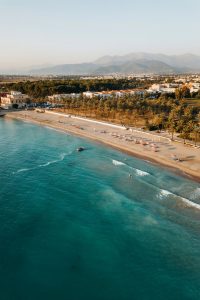
Location: 30 minutes from Palermo | Size: Sicily’s most popular coastline | Vibe: Relaxing, playful, radiant
Highlight:
That August evening at the Mondello Palace Hotel’s terrace restaurant, I’ll never forget it; I had Spaghetti ai Ricci di Mare (made with sea urchin, a salty masterpiece) served precisely at sunset. Every forkful was a poem.
LA VUCCIRIA MARKET – The Pulsing Heart of Sicily
When I first stepped into La Vucciria, I was drowning in sound—but this drowning was like listening to Sicily’s own heartbeat. Every meter holds a story: fishermen with wet fish in their hands, shouting not to be heard but out of necessity; lemon pyramids painting the pavement in gold; music, spice, and dust mixing in the air. Architecture? I can’t say—people and products hide it. But yes, there’s an Arab mosque in the center, as if it emerged from the market’s soul and was placed here. Even if you start the morning with your eyes closed, this market wakes you up—not by force, but with love.
I couldn’t resist La Vucciria in May—I immediately settled into the Lux Sincerae Boutique Hotel nearby, in the old town’s center, where Sicilian ceramics told their own stories in every room. I didn’t explore the market early in the morning because I wanted to arrive at the moment of the market’s awakening—that time was my time. I hired a guide and listened to the Renaissance of the Martorana Church, a 12th-century masterpiece just north of the market. At noon, I ate fish in the market—each fish seemed to have come out of water just that morning. In the afternoon, I sat at the historic Quattro Canti square—three centuries of architecture, looking as if it hadn’t aged at all.
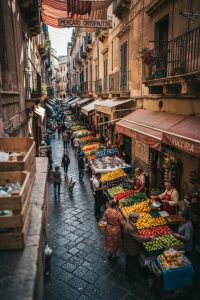
Location: Palermo’s old town (Vucciria neighborhood) | Size: A magnificent five-block market | Vibe: Exuberant, authentic, quintessentially Italian
Highlight:
In the middle of La Vucciria market, on Ballarò Street, I bought fresh Arancini from an old fish vendor—those golden, crispy rice balls filled with lentils and chicken. In that moment, the market’s noise seemed to fade away and I was left alone with the crispy shell, the golden exterior, and pure Sicilian flavor. That’s when I found Palermo’s soul!
THE MONDELLO-TO-CEFALÙ COASTAL JOURNEY – Never Enough Beauty
The road from Mondello to Cefalù was like an adventure, a discovery, and a gravestone all at once—past, present, and future could be seen simultaneously there. Car rental? Warning: Palermo traffic doesn’t test your nerves, it extracts your eyes. But the road itself? It’s legendary: a twisted coastline, lemon trees as if writing prophecies; limestone cliffs broken like a student’s failed sculpture; the sea a blue that Maldives would envy. Arriving in Cefalù, the massive Norman church stands dead center, bold, as if the church itself had grabbed the village and left it there. Time has stopped there—social media, planes, cars—none of them have reached that place.
I started my journey from the Principe di Villafranca—Palermo’s house for contractors and art lovers—where I spent two nights, a truly living place. I rented a car, though my heart didn’t feel brave enough, but I could feel it beating. In Cefalù, I settled at the Kalura Hotel—its windows opened to the sea, the terrace made forgetting about the sea nearly impossible. I spent my days exploring coastal coves; each one held a different mystery. I sat among the ruins of the Roman baths (Lavatoio Pubblico) and traveled two thousand years back in time. Evenings, I took boats to Lachea Island—the sea made leaving difficult.
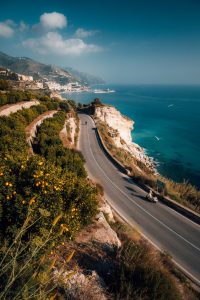
Location: North from Palermo, along the Tyrrhenian coast | Size: A 2-hour automotive journey | Vibe: Dramatic, innocent, unforgettable
Highlight:
I spent my first evening in Cefalù on a picnic boat headed to Lachea Island, where I had Pasta con le Sardine—made with sardines and chickpeas, containing yellow squash—a flavor that exists only in Sicily. The sweet sea breeze, beach sand, and that salty, rich pasta… This was one of the most beautiful dinners of my life.
MONREALE CATHEDRAL – Art Within Golden Light
When I discovered Monreale Cathedral, I asked myself: did heaven come down to earth, or did I rise from earth to heaven? An hour’s drive from Palermo, at the top of the mountains, this 12th-century cathedral sits waiting. Words fail. Every wall is covered in gold, every stone a blessing, every column a prayer. Mosaics, as if their creator had turned them into light itself. The town surrounding it—narrow streets, quiet elderly people—feels like a museum where time has stopped. There, you feel yourself stuck in history.
I left the Jugendstil balcony of Villa Igiea, rented a car—this time I wasn’t tempted to drive fast because I didn’t want to leave. I spent 3 hours in the cathedral and completely abandoned my camera because the light kept changing every second. I hired a guide and listened to the history (each master had a name, each stone a story). Then I walked through the market’s narrow, moonlit streets chewing village cheese—the best of Monreale lived in that cheese and those streets.
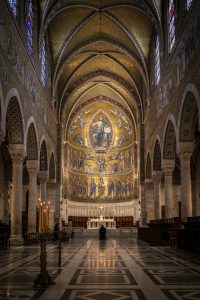
Location: One hour north of Palermo, in the mountainous region | Size: One of Sicily’s largest cathedrals | Vibe: Spiritual, luminous-light sanctuary, humble
Highlight:
After leaving the cathedral’s interior, I sat at the nearby Caffè Parco and had Granita di Mandorla (almond ice cream, a typical Sicilian morning treat) and Brioche (pastry with lemon sauce). With the exterior view and golden mosaics still gleaming in my eyes, this sweet combination was the perfect soul massage.
PALAZZO ABATELLIS – Compressed Treasures of Art
When I stepped through the Catalan-Gothic doors of Palazzo Abatellis, I decided never to leave—just kidding, they completely drew me in. This 15th-century palace, now serving as the Regional Gallery of Sicily, houses everything from Caravaggio to anonymous Sicilian masters. The courtyard, with its layered stones and finger-pressed arches—the poetry of architecture lives here. The main entrance? The Triumph of Death mosaic—so dark, so compelling, so melancholic. I’d never seen such a sad, yet magnetic reception. It doesn’t just draw you in; it takes your heartfelt library with it.
I came with an art historian friend—a friend like a library, telling stories about every painting. We stayed at the Politeama Palace Hotel, across from the opera center; music seemed to drift from the windows. I spent 4 hours in Palazzo Abatellis, looking at walls and nearly crying. I wanted to visit the Goethe Library but ran out of time—those books will grow old with me, apparently. In the evening, on Ballarò Street, I ate Sicily’s entire history on a single plate in a small restaurant.
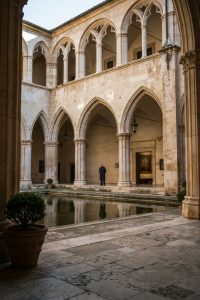
Location: Palermo’s old town, Kalsa neighborhood | Size: 3,200 square meters of art space | Vibe: Artistic, melancholic, inspirational
Highlight:
I couldn’t bring myself to leave Palazzo Abatellis, so I sat at the adjacent Caponata Café. I remember eating Caponata—Sicilian eggplant with tomato and hazelnut sauce—it wasn’t just food; it was Palermo’s state of mind itself. Hazelnuts, tomatoes, and sweet-salty eggplant aroma, combined with the gallery’s silence, became a soul-cleansing experience.
CAPPELLA PALATINA – Sanctity Beneath Shimmering Gold
Discovering Cappella Palatina felt like listening to a prayer written by a poet. This 12th-century chapel, hidden within the Norman Palace, is covered in gold—walls, ceiling, every corner a different praise. Sacred animals walk across the ceiling in Arabic script. The moment you enter, light embraces you and suddenly you’re no longer in the world—you’re in another time and space. Photography? No. Photography would murder this place; you must see it only with your eyes and heart.
In August, I visited Cappella Palatina at 7 a.m.—tourists were still sleeping, their sleep was my gain. I stayed at the Lux Sincerae Boutique Hotel in the old town’s center; every window showed ancient walls. In the chapel, I made an appointment with myself; I didn’t follow the Norman Palace guide’s tour. Hours later, when I emerged, I walked to the La Kalsa artist neighborhoods—artists were painting their walls, and I was painting mine. In the evening, I sat on the hotel terrace and drank arak—Palermo was teaching me the language of night.
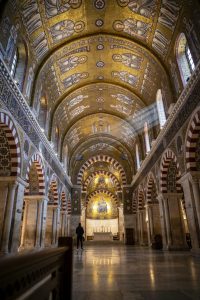
Location: Palermo’s old town, within the Norman Palace | Size: 33 x 15 meters | Vibe: Majestic, spiritual, golden-illuminated
Highlight:
After leaving Cappella Palatina, I sat on the hotel terrace and had Pasta alla Norma—made with eggplant, tomato, and ricotta cheese, a classic from Catania. While watching Palermo’s old town skyline, the sweet aroma of eggplant from my pasta seemed to perfectly capture Sicily’s essence.
TEATRO POLITEAMA – The Heart of Italian Opera
Walking into Teatro Politeama, your heart starts racing—perhaps inevitably. Built in 1874, this opera house sits in western Palermo, a building with two grand trumpet-like arches. Inside, red velvet chairs (their crimson now slightly faded, but all the more magnificent for it), a gold-decorated ceiling that turns—the acoustics that would shake your bones. Whether you’re an opera fanatic or simply a lover of beautiful things, this place awaits at every visit to steal from you.
I chose to stay at the Politeama Palace Hotel during my visit—the building stood right next door! Opera was performed frequently, and I caught a performance of La Traviata. Before and after, I wandered through the building—entire worlds in every corner, mysteries behind every curtain. I lost hours in the Galeria d’Arte Moderna. That night, at Piazza Politeama, with the opera’s musical dream still in my head, I had dinner.
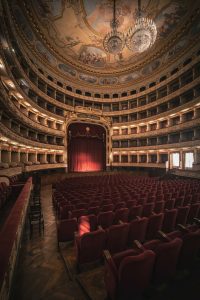
Location: Western Palermo, Libertà Square | Size: 3,000-seat opera house | Vibe: Elegant, cultural, nostalgia-filled
Highlight:
After the opera performance, I had the famous Sfincione Palermitano—Sicilian-style pizza with onions, sardines, and pickled beets—at Piazza Politeama. With the opera’s music still vibrating within my soul, this salty, umami-rich pizza converged into a complete Palermo experience.
KALSA NEIGHBORHOOD – Sicily’s Most Colorful Social Canvas
In the Kalsa neighborhood, surrounded by pastel walls and hanging laundry, we got lost—and I never felt lost. This place isn’t what Italian cinema would construct—there’s just life here; old, ordinary, loud life. Walls are covered with graffiti, each one a mark from some story; streets are narrow and laundry rains from above; the meatball vendor grandpa is always there; old women in windows, once chatting, still chatting. Barely any tourists—which is why life can actually work here. Palermo’s heart is here, but hearts, most of the time, are never loved.
To truly understand Kalsa, I hired a guide—but the guide wasn’t just a guide; they were the neighborhood’s elder, a story-carrier, memory. We walked for four hours and everywhere I saw the touch of a master—a shoemaker, working the same spot for forty years; a fabric merchant choosing fabrics for customers like an artist. The Church of San Francesco d’Assisi, quiet, forgotten yet beautiful as heaven. At the market (Vucciria’s younger sibling), vegetable vendors asked about my story, not the other way around. Can you understand Palermo? Only by looking into other people’s eyes.
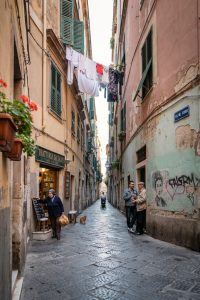
Location: Eastern side of Palermo’s old town | Size: A neighborhood spanning 20 blocks | Vibe: Authentic, colorful, exuberant, people-centered
Highlight:
In Kalsa, we sat at Antico Caffè Spinnato—a 150-year-old café right in the center—and had Granita di Caffè con Brioche (coffee ice cream and sweet brioche bread). People passing on the street, laundry hanging from windows, the sound of a clock vendor… This was what a real Palermo morning means.
SAN CATALDO CHURCH – Silence Beneath Pink Domes
Finding San Cataldo, I thought I was dreaming—pastel, pastel, pastel everywhere. At Piazza Bellini in Palermo’s heart, this 12th-century church’s dome stretches toward heaven—pink, green, white colors as if a rainbow had rained down paint. Inside? Simple, very simple; Arab-influenced architecture as if you could go to Algeria but remain in Italy. Piazza Bellini itself is where locals come to drink coffee—not tourists, but real people.
I walked from the Politeama Palace Hotel—just 15 minutes—and spent 45 minutes inside San Cataldo, abandoning my camera when I realized it couldn’t capture the light’s every shift. I visited the adjacent Martorana Church (12th century, Norman, another map). At noon, at a café on Piazza Bellini—I forgot its name but the table sat on stone street—I had pasta. Above my head, a pink dome; in my hand, sweet pasta; before my eyes, Palermo lived.
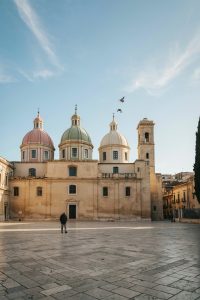
Location: Palermo’s old town, Piazza Bellini | Size: An intimate-scaled chapel | Vibe: Quiet, spiritual, pastel-radiant
Highlight:
Leaving San Cataldo, I sat at Caffè Napoli right next to Piazza Bellini and had Pasta e Ceci—chickpea soup, made exactly Palermo-style: olive oil, chickpeas, and pasta, so simple! The pink dome visible through the window, flower vendors scattering roses in the square… My soul was completely here.
THE MONDELLO-TO-ADDAURA COASTAL WALK – Seaside Meditation
The coastal walk from Mondello to Addaura didn’t come from any fairy tale—it was itself a fairy tale. Starting from Mondello Beach, following the seashore, transitioning from sand to rocky coves, this two-hour walk is essentially one of Italy’s most beautiful coastal routes. Turquoise sea, lemon trees singing, Monreale mountains in the distance, silent and calm. When the weather is clear, you can see as far as your eyes will allow. Some people just lie on the beach and get burnt by the sun, but I’m on the side of those who walk; this walk was my story.
I started from Mondello Palace Hotel at 8 a.m.—15 liters of water, sturdy shoes, and endless sea. For 2 hours, I walked through sand (footprints disappeared immediately); I climbed into rocky coves; at some coves, fishermen were present, and I passed them wordlessly (I had no words then). In Addaura, at a small fish restaurant, I had Zuppa di Pesce—fish soup, containing everything—fish, mussels, shrimp, coolness. Though sweat covered me, with every spoonful I drank the entire story of the sea.
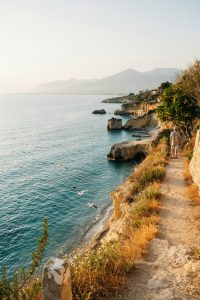
Location: From Mondello to Addaura, along the Tyrrhenian coast | Size: A 2-hour walk, approximately 8 km | Vibe: Calm, meditative, nature-saturated
Highlight:
Midway through the walk, I discovered a small cove called Cove of Vergine and there, from a local family’s boat, I drank sweet lemon. Later, at the Ristorante Al Faro at Addaura’s edge, I sat and had Zuppa di Pesce—mixed seafood, fish, mussels, shrimp in broth, Sicilian-style in olive oil. Sea breeze, fish aroma, and lemonade… This is what real Palermo living means.