Hanoi’s 10 Most Enchanting Places – I’ve Returned 15 Times, and There’s Still More to Discover!
When I first arrived in Hanoi, I didn’t understand the city’s chaotic pulse. Now, fifteen years and countless returns later, this city no longer understands me—because I’ve become it. Every street is a memory; behind every honking motorbike, a story. The symphony of engines, the steam rising from coffee cups, the narrow alleyways of the Old Quarter… these are my spaces now. Yes, I love luxury boutique hotels, yes I seek aesthetics. But Hanoi’s real magic isn’t found in travel guides—it lives in the heart, in those winding streets, in nameless café corners. I’m inviting you here. Here are Hanoi’s ten unnamed treasures—and why I keep coming back.
Hoan Kiem Lake – Hanoi’s Emerald Heart
You can feel Hanoi’s heart beating around Hoan Kiem Lake. The hundred-year-old trees know this, and so does the water. When silver rays touch the lake’s surface at dawn, the crimson Turtle Tower stands dead center—like a sentinel guarding the city’s soul. Local fishermen glide silently past in bamboo boats. The water is so clear that you see not the city but a painting within it. When mist, trees, and silence converge, you simply begin to sleep with your eyes open.
I arrived at Hanoi Old Quarter View Hanoi directly from Noi Bai. This boutique hotel felt like it was sleeping in the basement of the lake—every morning, the sound of water came through the windows. For five days, I spent my mornings on the lake. A fisherman named Đức took me by boat to hidden corners—places where water puppet performers rehearsed at night. I walked the entire 1.6-kilometer perimeter three times; each time discovering new café owners and flower sellers. When I visited Turtle Tower at sunset, the sun cast such orange-pink light that I swore fire was burning on the water.

**Location:** Hoan Kiem Lake, Central Hanoi | **Size:** 1.6 km perimeter, 30 hectares | **Vibe:** Serene, mysterious, meditative
Old Quarter – Hanoi’s Labyrinth of Love
Hanoi’s Old Quarter is a maze of narrow streets—and instead of getting lost, you find home. Space sits on space; each structure holds a story, each window a life. Mustard, coral, and olive colors wash the facades; the air smells of incense, frying oil, and patience. The calls of scrap collectors, butchers, tea merchants, the ring of motorbikes—none loud alone, but together they create a dream-music. Hanoi’s Old Quarter isn’t tourism; it’s the city’s heart, its lifeblood.
I stayed at Essence Hanoi Hotel for seven days—a 1920s columned mansion, now a five-room boutique palace. Every morning I’d wake to the chord of cyclo bells. This hotel was perfect for listening to the city’s heartbeat by touch. I cooked phở in its kitchen; a family shared all their secrets with me (the story of garlic-ginger-salt ratios). A five-hour street food tour: bánh mì, cơm tấu, grilled squid. At each stop, a vendor’s own epic. In the evenings, I captured the golden hour light—watching how it touched the weathered walls.

**Location:** Hanoi’s Old Quarter, Center | **Size:** 36 streets, ~15,000 residents | **Vibe:** Chaotic, authentic, deeply romantic
Văn Miếu (Temple of Literature) – Hanoi’s Statue of Wisdom
Văn Miếu, Hanoi’s intellectual heart since 1070. Five courtyards—each quieter than the last. Cypress trees shoot skyward; they seem to point to time’s source. Red walls, symmetrical pavilions, marble turtle stelae (each bearing the name of an ancient sage). Enter here, and time begins to sleep. Gravel crunches under your feet. Incense smoke clings to your hair. This place was made for reading books—yet you only want to sit as a wall.
I left early from Sofitel Legend Metropole (the 1901 palace) and went straight to Văn Miếu. No scholar guided me—perhaps that was better. In the turtle stela courtyard, 82 stones stood. Each stone carried an ancient sage’s name. I sat. People with silver hair walked past. Light turned—from morning’s flower-light to afternoon’s golden glow. For two hours, stone was stone, water was water, air was air—nothing chose not to be. Leaving, I bought a calligraphed scroll from an artist. It read: “You are not here.”

**Location:** 58 Guozijian Street, Dong Da District | **Size:** 54,000 m², 5 courtyards | **Vibe:** Spiritual, intellectual, profoundly peaceful
French Quarter – Nostalgia’s Elegant Space
The French Quarter is Hanoi dressed formally. Tree-lined streets—each tree seeming to arrive from Paris head to toe. Yellow houses, wrought-iron balconies, manicured gardens. Every swing of this neighborhood has been calibrated by an old ballet—step by step symmetry. Walls, cream-colored and silent—touch them, your hand becomes sticky (nostalgia). Windows closed; we don’t see who’s inside. Walking these streets, you jump a century—some Paris, some Hanoi, all dream.
I stayed at Sofitel for four days. Mornings: walking Trần Hùng Đạo and Ngô Đức Kế streets (not with camera, with eyes—to truly see). In the French colonial palace of the National Museum, a billion things—but none made me happy. The Opera House (1911)—I went. Red velvet seats, gold scrollwork, the curtain’s amber light. Schubert (German), but Hanoi wasn’t speaking. Afternoons at Ciao Hanoi Café—Vietnamese coffee (thick, black, sweet)—watching the street perform in its cup.
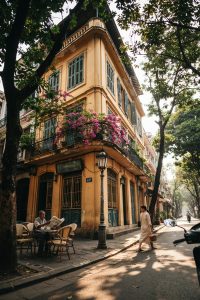
**Location:** Central Hanoi, Hoan Kiem & Hoang Hoa Tham Districts | **Size:** ~15-20 main streets | **Vibe:** Elegant, nostalgic, romantic, refined
Ho Tay (West Lake) – Hanoi’s Hidden Paradise
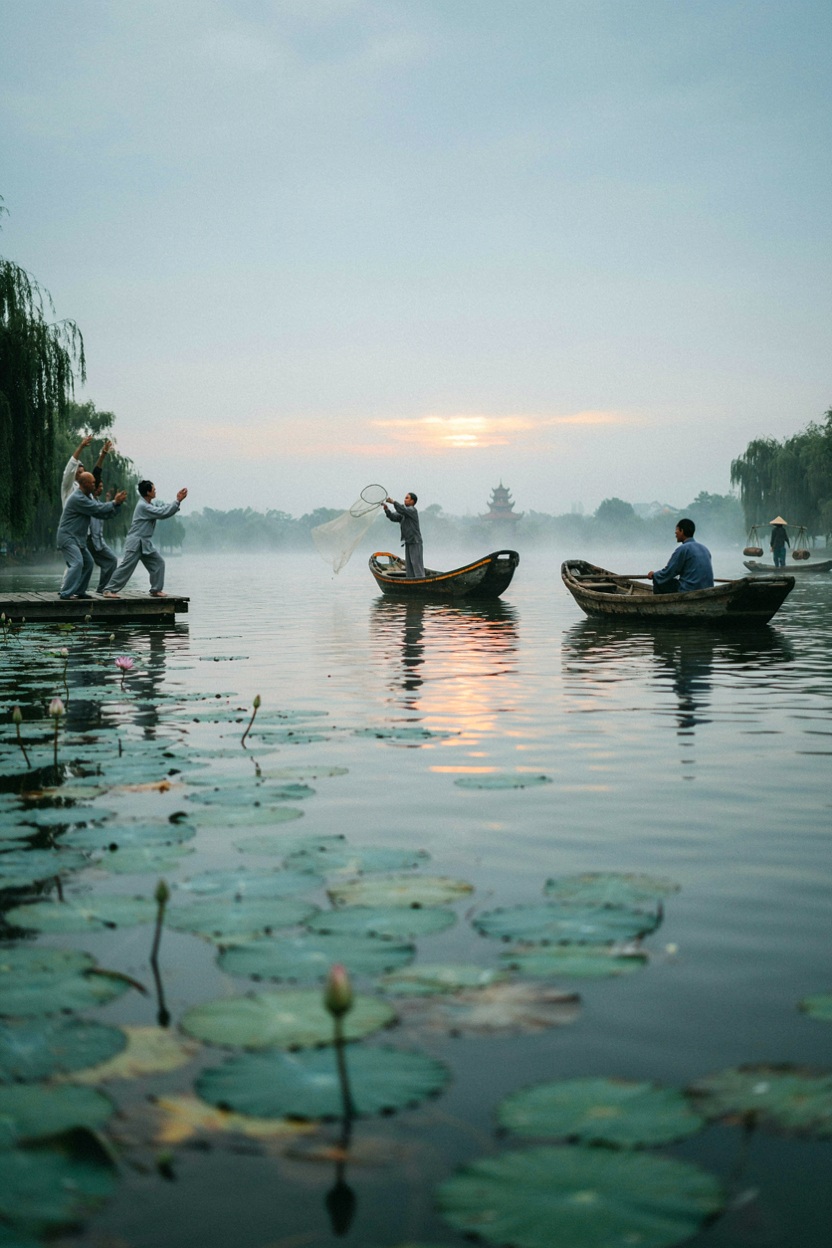
Ho Tay is Hanoi’s interpreter lake. Here, everyone is given a secret—but no one listens. Water circles 17 kilometers; you circle too, like water. Willows sleep; the temple (Trấn Quốc) hides in leaves. At dawn, fishermen cast nets—as the net falls, so does the world. A tai chi master stands on a floating platform, literally drawing railings into air. This lake has no equal. Sleep awakens; waking sleeps.
I stayed at La Siesta Spa for three nights. Every morning, kayaking around the entire lake (16 km)—I never spoke. Trấn Quốc Pagoda (Vietnam’s oldest), meditation (inner meditation, not outer). At the hotel, traditional massage: hot stones, turmeric. Ninety minutes—time froze. Afternoons, a wooden boat, reading in shade, water sounds (music). I read inside the water—no, I didn’t read, I became water.

**Location:** Northwestern Hanoi | **Size:** 500 hectares, 17 km perimeter | **Vibe:** Tranquil, spiritual, restorative, romantic
Water Puppet Theatre (Múa Rối Nước) – Hanoi’s Hidden Art
Water Puppet Theatre is a 600-year-old living death—UNESCO knows this, but UNESCO doesn’t care. Behind the curtain (below water level), performers—invisible, limitless in power. Worn wood carved from refined fire, the puppet actor. Drum sound; bamboo flute; silk bow. Song—but what does it say, I don’t know. A fisherman puppet catches fish, catches fish, sleeps with fish. A god (Ngọc Hoàng) descends from the mountain—so heavy, so airy. I sat. I cried. The people who do this, creating gods, extract themselves.
From Hanoi Old Quarter View, six days; to Thang Long Theatre, I went three times. On the third, I met a performer (off-protocol). The master puppeteer gave me a stick for the water—”you also carry silk,” he said. Afternoon show, evening show, night show—each with different puppets. The same fisherman? The afternoon fisherman occupies a space the morning doesn’t. Then, in the plaza café, I sat. My coffee was cold, but I was hot. Humans seemed more artificial than water puppets.

**Location:** Thang Long Water Puppet Theatre, 57A Dinh Tien Hoang Street | **Size:** 300 seats, 600-year-old tradition | **Vibe:** Magical, culturally profound, utterly captivating
Ho Chi Minh Mausoleum – Hanoi’s Monument to Stillness
Ba Dinh Square: stone and humility and silence. The mausoleum (granite and limestone) swells but doesn’t crush—it’s almost a sigh (deep breath). Guards surround it (uniforms pristine, faces old). Tourist line—no extraction choice. Inside, Ho Chi Minh’s premonition (under protection). At center, a wrinkled stone; the people’s prayer. Your outside stays outside, your inside stays inside. In corridors, no one speaks. Footsteps sound like fetishes. You carry one man’s death’s weight—just the weight, not the light.
I left Sofitel early (formal attire). Clothing: long pants, buttoned shirt (protocol or respect, who knows). Line (50 people). Inside (2 hours): silence in chambers, photographs (young Ho, old Ho, dead Ho), stilt house (wood, time stopped). In gardens, I sat. My step stopped there—but history continues. One man’s corpse holds millions in memory. Heavier than graves, this.
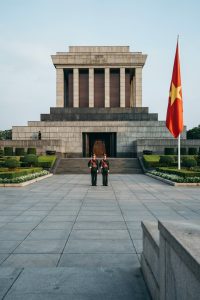
**Location:** Ba Dinh Square, Northwestern Hanoi | **Size:** 320,000 m² complex | **Vibe:** Solemn, profound, historically significant, meditative
Dong Xuan Market – Hanoi’s True Memory
Dong Xuan Market (the nation’s oldest), three stories, a thousand stalls—but this is more a living museum than market. Air: turmeric (yellow), fish sauce (grey), garlic (fruity), fresh coriander (green). All together? Olfactory coma. The corridor is narrow—one shoulder pamphlet, the other fish-ink smell. Negotiation (vendor-customer dialogue): “How much?””Very expensive?””Lower the price, you’ll sell more.””Okay.” Truth lives inside words. In this market, if not Hanoi, what is? Silk, metal, flowers, fish, tea—all breaths. This is Hanoi’s spine.
From Essence Hanoi (five days), I went to Dong Xuan at 6:30 AM (no tourists). My guide (Linh) has known the market for 40 years—at one stall, an old yellow vendor; at another, her son. A generation passed. Food tour (buy → cook → eat): wet carp, fresh onion, butter, Hanoi style. Third floor: silk (colorful, old, hand-stitched). Holding. How many years did this silk live in how many hands? I raised my camera but didn’t shoot—just looked. This wasn’t photography; this was flexibility.

**Location:** 53 Dong Xuan Street, Old Quarter | **Size:** Three-story building, 1000+ vendors | **Vibe:** Chaotic, authentic, intensely energetic, truly Hanoi
Ninh Binh Trang An – Awakening Legend Near Hanoi
Trang An (Ninh Binh, 100 km south of Hanoi), a stone theater—limestone stage, green water curtain. Mountains (500 m) at dramatic angles—like obelisks planted by a sculptor’s hand. Unlike Halong Bay: Halong entertains, Trang An worships. Water passages (narrow, rocky)—kayaks can’t enter. You need a tebek (traditional boat). A shamanistic police voice (like steel). Caves (old stone working, old churches, old bodies). Time froze. Pole sound (the boatman’s prayer-like thrust into water). All dream. But if dream is too real, is reality dream?
I drove from Sofitel at 7 AM. Ninh Binh (2 hours). Heritage Hotel Ninh Binh (hilltop, valley view). Minh (boatman) all day with tebek. Caves (old Muslim-carved shapes?). Mua Mountain (500+ stone steps, heart exit). At summit, smoke. Each breath accepted like a flower. Rock kayaking (smaller passages, more silence). Hoa Lu (ancient capital, temples, street). Before leaving, I tried to remember Trang An—but memory closed. Only body would remember.

**Location:** Ninh Binh Province, 100 km south of Hanoi | **Size:** 30,000 hectares UNESCO site | **Vibe:** Mythical, awe-inspiring, profoundly beautiful, slightly otherworldly
Hoa Binh Silk Village – Hanoi’s Palace of Handicraft
Hoa Binh (“Peace” meaning), 45 km southwest of Hanoi—silk village (16th century onward). Scene: wooden houses, mulberry trees (silkworm food), open-air weaving looms. Mechanism: loom strike, turning parts, silk tension. Human (weaver): old, patient, predicts every thread (hundred-year memory). Light (golden hour): comes 2 hours before sunset, stays 2 hours after—the village lives in perpetual crepuscule (twilight endures). Sound: loom sound (rhythmic), bird sound (sporadic), human sound (almost none). This place isn’t the world’s heart but its mind. Culture settled here, not tourism.
Three days from Sofitel (private car). Villa Soie (family-run, five rooms). With artisans: 1. Cocoon degrading (silkworm’s eye, micro unseeing-blind) 2. Spinning turn (silk thread, very thin, very fragile) 3. Dye vats (indigo: deep blue, turmeric: yellow, madder: red) 4. Weaving (wooden loom, foot and hand, brain closes) Each artisan gave me a scarf. Scarf=story (who made, silk what color, inspiration what). One scarf special: male weaving (rare), indigo (natural), patterns (seventy-year motif). That silk cloth, I loved. Body is soul.

**Location:** Hoa Binh Village, Hoa Binh Province, 45 km west of Hanoi | **Size:** Small artisan village, 2000+ inhabitants | **Vibe:** Peaceful, artistic, meditative, beautifully preserved
CLOSING: Returning to Hanoi Isn’t Choice—It’s Necessity
Ten places: only ten faces of Hanoi’s infinity. City: a country of contradictions—old+new, chaos+peace, filthy+clean—but these don’t cancel; they produce. Each return, a new secret (or old secrets’ rescue). Hanoi isn’t a checkmark city; Hanoi is love city—slow, completive, transformative. It redefines beauty, authenticity, the simple act of existing in the world. Come here. Get lost in streets (but is it home? Watch out). Eat food (alongside chewing, chew philosophy). Listen to stories (oral history). Return. Find me. Tell me: “Hanoi was like you, but in different color.” I know you’ll say this because I always do. Returning to Hanoi: not choice—necessity.