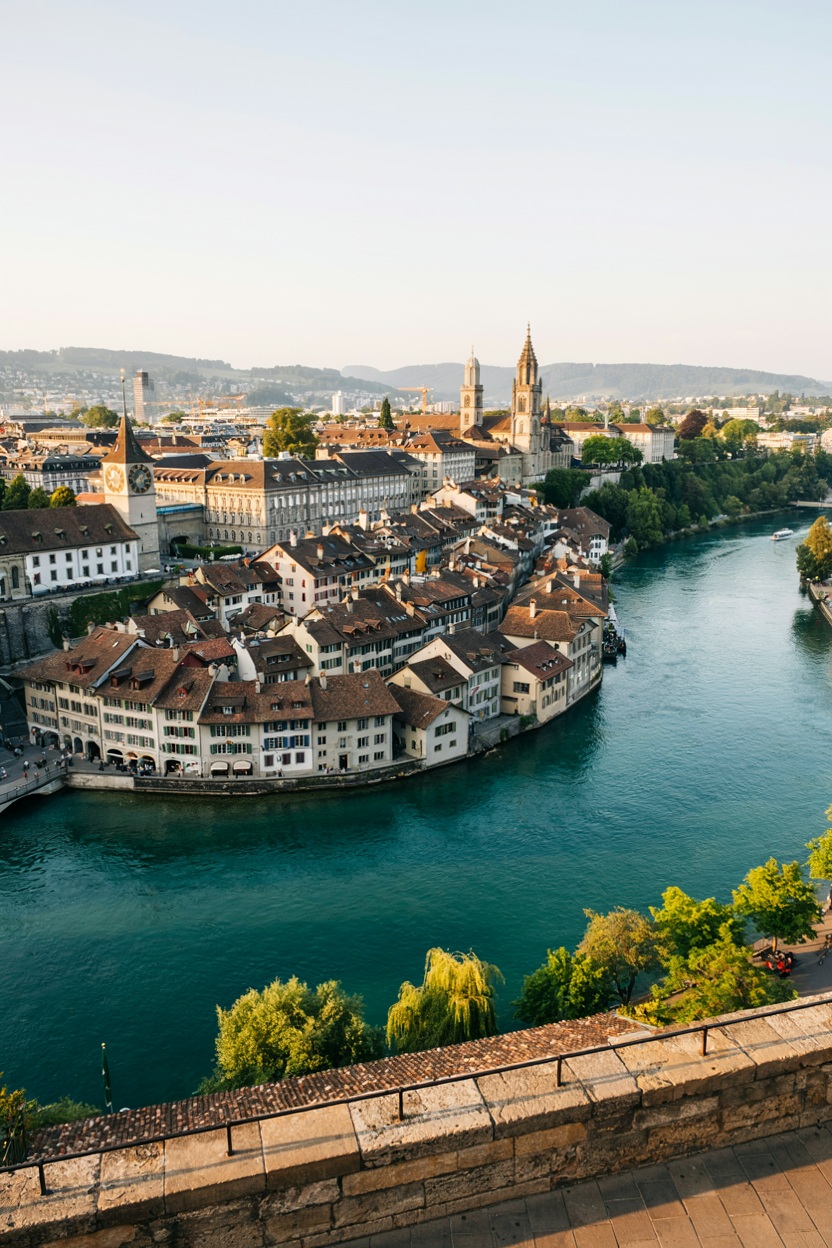
Switzerland and I — this is a love story. And I’ll admit it: I never wanted it to end.
It all began years ago, when I was still very young, during the snow-white months I spent one winter in Interlaken. Snow-light spilling through the window, distant cowbells, the fog I wiped from the glass with a finger.
I’ve returned ever since. I’ve leaned against the misted windows of cog railways. I’ve watched the sun melt behind the Alps from lakeside terraces. And I’ve always missed the same place.
And every single time, I left with a wheel of Gruyère and a handwritten recipe in my bag.
This piece is for the travel snobs who flee tour buses, who love beauty, who want to feel a place rather than merely see it. In other words, for people like me.
Here are the 10 stops that stole my heart. And my favorite isn’t the one you’d expect.
1.Zermatt
The moment I set foot in Zermatt, I surrendered completely; my bag nearly slipped from my hand.
As you walk the car-free cobblestones, the Matterhorn suddenly appears from behind red geraniums spilling off wooden balconies — so sharp it looks as if someone drew it onto the sky by hand.
At first light the summit turns pink; the locals call it alpenglow. I could have wept without shame.
I flew into Geneva, changed at Visp and boarded that little panoramic train; as the wheels counted out tik-tak, the valley narrowed. Zermatt is car-free — the last stretch goes only as far as the rails will take you. And that’s half the magic.
For four nights I stayed at the Monte Rosa Boutique Hotel, the village’s very first hotel. The rooms where Edward Whymper spent his last night before the first ascent of the Matterhorn are still there — a historic four-star dating to 1839.
My days were full: sunrise on the Gornergrat cog railway; the Matterhorn trembling in the water of Stellisee on the Five Lakes Walk (5-Seenweg) as my breath fogged; the glacial chill of Matterhorn Glacier Paradise.
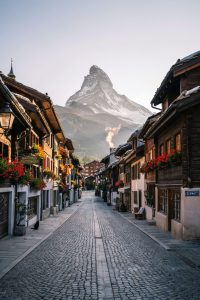
Location: Canton of Valais (Wallis), near the Italian border | Size: ~5,800-person mountain village, 1,620 m | Vibe: Majestic, romantic, timeless
My personal highlights…
“On the terrace of Chez Vrony in Findeln, the village looked tiny below as my fork sank into the cheese. A Walliser Teller: air-dried beef (Bündnerfleisch), local mountain cheese, pickles; then a sizzling raclette. View, salt and sun — the most peaceful meal of my life.”
2.Lucerne
Lucerne told me at a single glance why Switzerland is everyone’s postcard.
The 14th-century covered wooden Kapellbrücke over the Reuss and the octagonal water tower beside it, mirrored in the water, are like stained glass fallen into the river.
Hand-painted frescoes line the facades of the riverside guild houses. At the foot of a fountain, a child was floating a tiny boat. Behind it all, the silhouette of Pilatus.
As the morning mist rises off the lake, the city turns into a dream.
I came by a pleasant one-hour train from Zurich Airport. I stayed two nights at Hotel des Balances — a 12th-century four-star superior on the Weinmarkt, dazzling with the faded gold gilt on its facade.
I saw the Löwendenkmal (Lion Monument) carved into the rock — the lion Mark Twain called “the saddest stone in the world.” I sailed the lake on an old paddle steamer. I climbed Pilatus on the world’s steepest cog railway.

Location: Central Switzerland, on Lake Lucerne | Size: ~82,000 population | Vibe: Elegant, romantic, picture-perfect
My personal highlights…
“At Wirtshaus Galliker, run by the Galliker family for four generations, a Luzerner Chügelipastete: veal and mushroom in a creamy sauce inside a buttery puff-pastry shell. The chatter of locals, the clink of forks, floral curtains — a table that travels back in time.”
3.Lauterbrunnen
I’d read of the “valley of 72 waterfalls.” But the instant I entered it, I realized no photograph could do that drama justice.
Sheer cliffs on both sides. Thin veils of water sliding between them. And the Staubbach, falling almost 300 meters — scattering in the wind before it ever reaches the ground.
In this view that once moved Goethe to write a poem, it’s as if someone had turned reality’s volume down.
When the clouds come down, the village vanishes into the mist.
I arrived on that little valley train via Interlaken. I stayed two nights at Hotel Silberhorn — a traditional chalet off the main road, smelling of pine, its balcony facing the Staubbach head-on.
I descended into Trümmelbach to see the glacier waterfalls inside the mountain. I rode the cable car up to Mürren, then on to the Schilthorn (Piz Gloria). I made a little escape to tiny Wengen.

Location: Bernese Oberland, Jungfrau region | Size: ~2,500-person valley village | Vibe: Dramatic, fairytale, peaceful
My personal highlights…
“On the hotel balcony, I waited for sunset with a tea in hand. My tea went cold; I didn’t care. In the last light the Staubbach turned into a silver curtain; as the wind scattered the water, it hung in the air. In that moment I didn’t want to be anywhere else.”
4.Grindelwald
Grindelwald placed the full grandeur of the Alps in my palm.
Directly across from the village, the legendary north face of the Eiger rises like an enormous stage curtain; the houses at its foot look no bigger than buttons.
Cows graze the emerald meadows, their bells echoing down the valley. Wooden chalets, geranium balconies, and that snowy summit behind.
I drank my morning coffee facing that wall; my fingers wrapped around the cup, and as the light roamed the face the view changed by the hour.
I came on a short connection from Lauterbrunnen. I stayed two nights at the Romantik Hotel Schweizerhof, Swiss Alp Resort & SPA; when I drew the curtains, the Eiger filled the entire window.
I rode the Grindelwald-First gondola and walked the cliff-hugging First Cliff Walk — meters of nothing beneath my feet. I climbed to the mirror-lake Bachalpsee. I rode up to the “Top of Europe,” Jungfraujoch.

Location: Bernese Oberland, at the foot of the Eiger | Size: ~3,800 population, 1,034 m | Vibe: Majestic, lively, alpine
My personal highlights…
“After a long hike, a steaming Älplermagronen: the shepherd’s macaroni — potato, creamy Alpine cheese, fried onions — with homemade apple sauce on the side. I melted the fatigue of the walk right there on the plate.”
5.Montreux
Montreux is Switzerland’s sun-struck, Mediterranean face.
Walking the palm-lined promenade along Lake Geneva, behind the Freddie Mercury statue it’s as if a guitar riff still hangs in the air.
The water is clear, the mountains close. Come late afternoon the whole shore turns to melting honey.
I came in an hour along the lakeshore from Geneva Airport. I stayed two nights at the Grand Hôtel Suisse-Majestic — built in 1870; travelers who stepped off here a century ago saw this very same view.
I toured the 13th-century Château de Chillon rising from the water. I walked the UNESCO-listed Lavaux terraces; the vineyard stones still held the noon heat. I tasted wine with a local grower.
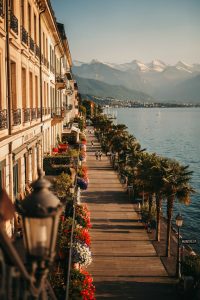
Location: Canton of Vaud, Lake Geneva, Swiss Riviera | Size: ~26,000 population | Vibe: Elegant, luminous, nostalgic
My personal highlights…
“On the hotel’s lakefront terrace Le 45, filets de perche: the tiny perch fillets of Lake Geneva, sautéed in butter, lemon and parsley; the butter on my fork gleamed in the light off the lake. Beside it, a cool Chasselas (St-Saphorin) from the vineyards above.”
6.Zurich
Anyone who thinks Zurich is “just a finance city” is mistaken.
I fell for the elegant Old Town (Altstadt) spread along both banks of the Limmat. Colorful guild houses, the twin towers of the Grossmünster, the Bahnhofstrasse with its chicest windows; in one of them I smiled at my own reflection.
In the back lanes, bohemian Niederdorf. The creak of trams, church bells, reflections on the water. Sophisticated and warm at once.
Twelve minutes by train from the airport brought me to the center. I stayed two nights at the Storchen Zürich — on the Weinplatz; from the window the Limmat flowed by in the morning light.
I climbed the tower of the Grossmünster and looked out over the rooftops. From Bürkliplatz I set out onto Lake Zurich. At the Kunsthaus I lingered too long in front of a Giacometti.

Location: Canton of Zurich, northern tip of the lake | Size: ~440,000 population | Vibe: Chic, dynamic, sophisticated
My personal highlights…
“At the Kronenhalle — open since 1924, its walls covered with Picasso, Chagall and Miró — a Zürcher Geschnetzeltes: paper-thin slices of veal in white wine, cream and mushrooms, with a crisp-edged rösti alongside. Behind my fork, the blue of a Chagall.”
7.Lugano
Lugano is Switzerland’s Italian-speaking heart, head over heels for the sun.
On the shore of Lake Ceresio: pastel buildings, palm trees, locals sipping late-afternoon espresso; the clink of cups and saucers and laughter in Italian.
The arcaded boutiques of Via Nassa. Parco Ciani sloping to the lake. Oleander and lake on the air. Monte Brè and San Salvatore rising on either side.
I came in an hour from Milan Malpensa. I stayed two nights at the Hotel Splendide Royal — standing on the Riva Caccia since 1887, carrying all the grace of its era.
I rode the Monte Brè and San Salvatore funiculars. I visited the LAC arts center and the MASI. As the boat pulled from shore the water deepened; I reached the fishing village of Gandria.

Location: Canton of Ticino, Lake Ceresio | Size: ~62,000 population | Vibe: Mediterranean, elegant, sunny
My personal highlights…
“On the hotel’s lakefront terrace La Veranda, as the evening sun spread across the water, a velvety mushroom risotto and a glass of Ticino Merlot. Crossing from the mountain air of the north to this soft southern evening was a journey in itself.”
8.St. Moritz
St. Moritz taught me that glamour has a name in the Alps: the Engadin.
Around the turquoise lake, stone houses with traditional sgraffito etched on their facades. Glittering shop windows. Mountain air so clear it burns the lungs.
In winter this town sparkles under snow. Looking down at the lake from the summit of Piz Nair, I forgot to take a photo — for the first time.
I came on a three-and-a-half-hour panoramic train — part of the legendary Glacier Express route. I stayed three nights at the Kulm Hotel; a century of footsteps lives in its lobby, because modern winter tourism was born right here in 1856.
I rode up Piz Nair. I walked around Lake St. Moritz. I shivered before the canvases of Segantini, the man who painted light. I watched the legendary Cresta Run from the edge of the ice.

Location: Graubünden, Upper Engadin, ~1,800 m | Size: ~5,000 population | Vibe: Luminous, aristocratic, alpine
My personal highlights…
“At Restaurant Engiadina, a true Engadin table: Capuns — dumplings of dough with Salsiz and cheese wrapped in chard leaves, cooked in broth — and Pizzoccheri. For dessert, a slice of Engadiner Nusstorte from Konditorei Hanselmann. Snow outside, this warmth within.”
9.Bern
Stepping into Bern, I understood that the capital is also one of the most romantic secrets.
The UNESCO-listed Old Town is set inside a glacier-green bend of the Aare. Six kilometers of arcaded passages (the Lauben) let you wander even in the rain.
A historic fountain on every corner. On the hour the golden rooster crowed and the bear figures of the Zytglogge turned. Sandstone buildings, red roofs, the river’s panorama.
I came in an hour from Zurich. I stayed two nights at the Bellevue Palace — an Art Nouveau building from 1913; at breakfast, at the next table, there was — I think — a real diplomat.
I watched the mechanism of the Zytglogge. I wandered the arcaded Lauben. At the BärenPark, when a bear cub slipped into the water, everyone fell silent. I climbed the Münster tower. I discovered the Renzo Piano-designed Zentrum Paul Klee.

Location: Canton of Bern, bend of the Aare river | Size: ~135,000 population, capital city | Vibe: Medieval, elegant, serene
My personal highlights…
“In the vaulted historic cellar of the Kornhauskeller, beneath the stone arches, a Berner Platte: boiled and smoked meats, ham, sausage, sauerkraut. Beside it, the onion tart Zibelechueche; the sweetness of the onion took me by surprise.”
10.Gruyeres
To enter Gruyères is to step onto the first page of a story.
A walled medieval town set atop a hill. A single car-free cobblestone street. A flower-ringed fountain in the middle. And whenever I looked up from any lane, there it was: the 800-year-old Château de Gruyères.
Green hills all around, grazing cows, and the smell of cheese in the air.
Once the day-trippers were gone, by evening only my own footsteps and the light of the castle remained.
Halfway between Montreux and Bern, I came in an hour from Geneva. I stayed one night at the Hôtel de la Fleur de Lys — in a 350-year-old building; the stairs spoke with every step.
I toured the Château de Gruyères and its knights’ hall. At La Maison du Gruyère dairy, the smell of warm milk rose from copper vats. I stopped by the eerie HR Giger Museum and the Maison Cailler chocolate factory in nearby Broc.

Location: Canton of Fribourg, Sarine valley | Size: ~2,000-person medieval town | Vibe: Fairytale, delicious, tranquil
My personal highlights…
“At the historic wooden Le Chalet de Gruyères, a bubbling fondue moitié-moitié: half Le Gruyère AOP, half Vacherin Fribourgeois AOP, a little white wine and kirsch. For dessert, meringue with crème double de la Gruyère and fresh raspberries. And no fondue ever tasted the same again.”