Hello friends! As someone passionate about jewelry making, if you’re also interested in starting this beautiful hobby, I’ve prepared this article for you. Honestly, when I first started designing jewelry, I never thought that “just tying a knot” would be so important. But over time, I realized that what creates a beautiful and durable piece of jewelry lies in the most fundamental part: the knots.
First Meeting: Overhand Knot
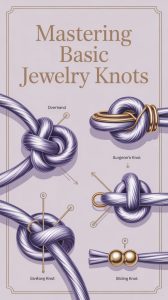
I recommend starting with the Overhand Knot. This knot is actually as simple as we remember from childhood. As the name suggests, you curve the thread upward and pass it through from bottom to top. And just like that, you’re done!
Why is it so important? Because this knot is very useful at the beginning and end points of your jewelry. Especially when you need to secure the ends of your wire, this knot becomes your guide. As you can see in the image, it’s formed in a quite simple way.
My practical advice: Start with thick wires at first, so you can feel the knot in your hands. Then gradually move to thinner ones. Trust me, this knot will never leave you halfway through.
Strength and Durability: Surgeon’s Knot
Now let’s move a bit further and meet the Surgeon’s Knot. This knot gets its name from surgeons because it’s also used by medical professionals. Honestly, I fell in love with this knot.
If you ask how it’s done: You bring two wires side by side and tie a knot. But we’re not finished! You go through the same path one more time. Think of it like a double locking system. This allows the knot to be locked twice.
Why is it so strong? Because it locks from both sides, it never slips or unravels. If you’re someone like me who worries, and you want your jewelry to never break, this knot is perfect for you.
I strongly recommend using Surgeon’s Knot especially when making heavy or valuable jewelry. As you can see in the image, when combined with gold rings, it also looks professional. After tying this knot, you’ll feel like a real jewelry designer.
Flexibility and Aesthetics: Sliding Knot
If you’re like me and love adjustable jewelry, Sliding Knot will become your best friend. The best feature of this knot is that it gives you flexibility.
Think of it this way: You’ve made a bracelet, but it doesn’t fit everyone the same size. That’s when the sliding knot comes into play. Thanks to this knot, you can adjust the size of your jewelry. When you want it tight, you can tighten it; when you want it loose, you can loosen it.
How is it done? You bring two wires parallel to each other and pass beads or metal accessories over them. Then, you tie a knot on both sides of these beads. Because the wire passes between the beads, it can move easily and you can change the size.
In the image, the sliding knot made with gold beads looks absolutely amazing. It’s both functional and beautiful. The first time you make this knot might seem difficult, but after a couple of tries, it becomes very easy. Trust me, you’ll master it too.
Professionalism: Sivaang Knot
Finally, let’s talk about our most sophisticated knot, Sivaang Knot. When I first heard the name, I thought, “Wow, this must be incredibly complicated.” But as I worked with it, I realized that this could also be learned.
Sivaang Knot has a slightly more complex structure. As you can see in the image, it’s made with metal wires and pins. This knot gives your jewelry a truly professional appearance.
How is it done? You curve the wire, wrap it in a special way, and secure it with the help of pins. Although it seems complicated at first glance, when you progress step by step, you realize it’s actually a logical system.
The biggest advantage of using this knot is that it gives your jewelry an artwork-like atmosphere. If you’re like me and want to create things different from others, I definitely recommend learning this knot.
Practical Tips
When making all these knots, it’s helpful to remember a few basic rules:
First, choose your wires carefully. Working with thick wires in the beginning makes the job much easier.
Second, be patient. Knots aren’t things to be made quickly. Create each knot carefully.
Third, practice. Not everything will be perfect at first, but you’ll get better with every practice.
Finally, believe in yourself. Millions of people tie these knots, and you can too!